Trisha Low on tastas at kidkid (July, 2025)
The light-image that spills from Fran’s installation is soft like fabric, so I stick my head around the corner, my body a fold. A sign tells me I should unwear my shoes. Hand against wall, weight on one foot. The gestures I make bodying forth a too-familiar invitation. “Oh, I’m sorry, but do you mind—” Composed of hanging denim textiles, repurposed and stitched together from piles of disassembled jeans, the threshold of tastas at kidkid seems to hinge at multiple forms of belonging—to be a body, or its alienated labor, a guest or a host, to play or be played with, to provide shelter or be held by it. Here, the form of the jean is iconically American, yet in seeming ready-made, masks the systems of production, colonial expansion and physical trace that compose its making. But by manipulating the jean—ripping, bleaching, draping, Fran excavates these subterranean dynamics via embodied action. Her installation wide open to resignification through my active, sensory experience of it. Are these makeshift tents, or imaginary forts, shed skins or ornamental coverings? Patterned as they are by video projections of her hands, unstitching jeans in an endless loop, I note most the tangible evidence of domestic work, set against the immateriality, indeed invisibility, of its skilled labor.
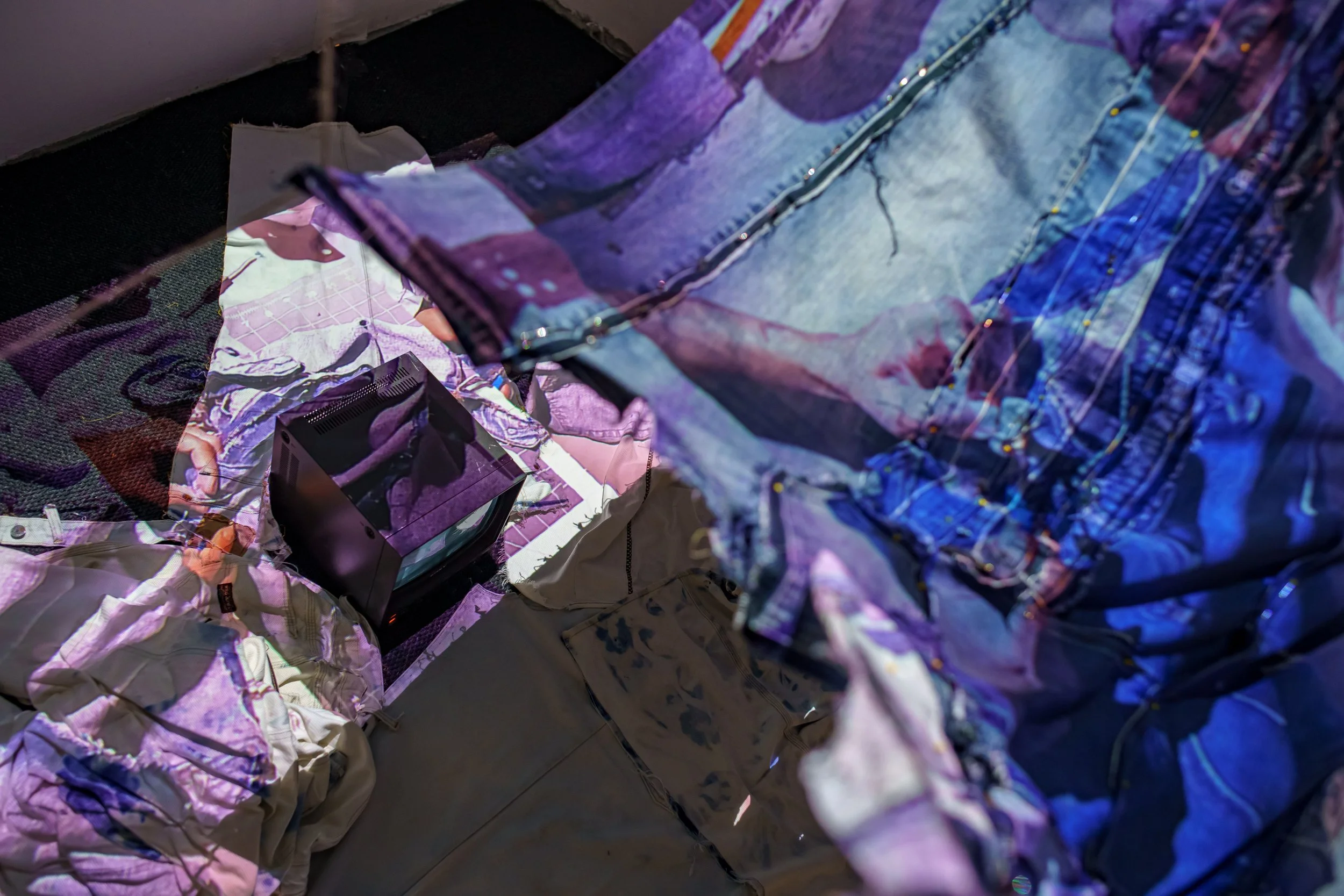
In the throes of late capitalism, domestic work is often synonymous with not preservation but replacement. At a hotel, a dirty towel is removed in favor of a clean one. Toys are not mended, but break at plastic joints and stacked high at Walmart. Filipino domestic helpers in Southeast Asia are catalogued by agencies, interchangeable faces to be casually hired and fired at will. But no matter how far it is alienated or displaced, domestic work is still confusingly inextricable from care. And Fran’s installation materializes the paradox, the eternal tensions and textures, of paid domestic labor—in that it is both work and care. In that domestic helpers inhabit a precarious balance of work that is care and care that feels like work; care as affectively intimate, and care as efficient task, a balance that requires constant energy and maintenance to sustain. In one of Fran’s videos sequestered in a high alcove above her denim structures, a domestic helper who might care for children not her own, gives a massage on her day off to Fran, a mother who labors for her child. This helper is being paid, but this remuneration, in the context of a community gathering is a different maintenance economy, more like adapting to need, than wages from an employer. Like mutual recognition. Her capable touch on Fran’s body marking the overlaps and intangible distinctions between them. There is an ambient feeling in the installation, much like its hanging structures, of always being ‘on the hook’, of being tangled or pulled taut or torn between the world’s demand to inhabit a functional shape, and alternative methods of mending or repair that can be a means of finding more adaptive, transient, intimate states. Crucially, that possibility, as Fran notes, also has to do with destruction, of ripping the seams of pre-existing systems apart.
When I take off my shoes, I think about how Pauline Oliveros offers this score: “Walk so silently that the bottom of your feet become ears.” I see a picture of Fran’s child in the installation and imagine he is not silent but chatters curiously, with joy as he steps across the soft fabric covering. I am sure in this way, he listens to the experience deeply. I worm my way under the covering and smell the crispness of fresh laundry, sun-soaked bleach. Look up and see a chink ripped open in the flayed butt-surface of a pocket. Letting the light in. I lay on the ground, not under the sky, but under the rippling embrace of a film-representation, which is also a spectral body. I listen to the air, the dampened chattiness, a makeshift gathering of Filipino workers on their day off. I think about the winding skyline of a place not-home, stretched and distorted by tears. The social formations of care that have become ensnared by capital but also swim amniotically around its rigid structures. I think about Fran’s child, tracing invisible paths through the twine, looping our play together, then about how domestic labor is often taught as play, feeding the doll, waving the broom. I note how my favorite thing about my experience of Fran’s piece is the small gaps in the stitching, where the video spills through, leaving space for what might enter or what we might banish into shadow. What in the face of the collective care, or demand, might turn on its heels and disappear.